Getting your first job in the IT industry can be challenging, especially when you are a fresher with no professional experience. Many companies in India evaluate candidates through aptitude tests, technical interviews, coding rounds, and HR discussions.
The good news is that you do not need to know everything to get selected. You need strong fundamentals, problem-solving ability, practical knowledge, and confidence. This roadmap explains the important topics and preparation strategies that can help you prepare for technical interviews.
1. Understand the Technical Interview Process
Before starting preparation, understand the common recruitment process followed by IT companies. The exact rounds may differ depending on the company and job role.
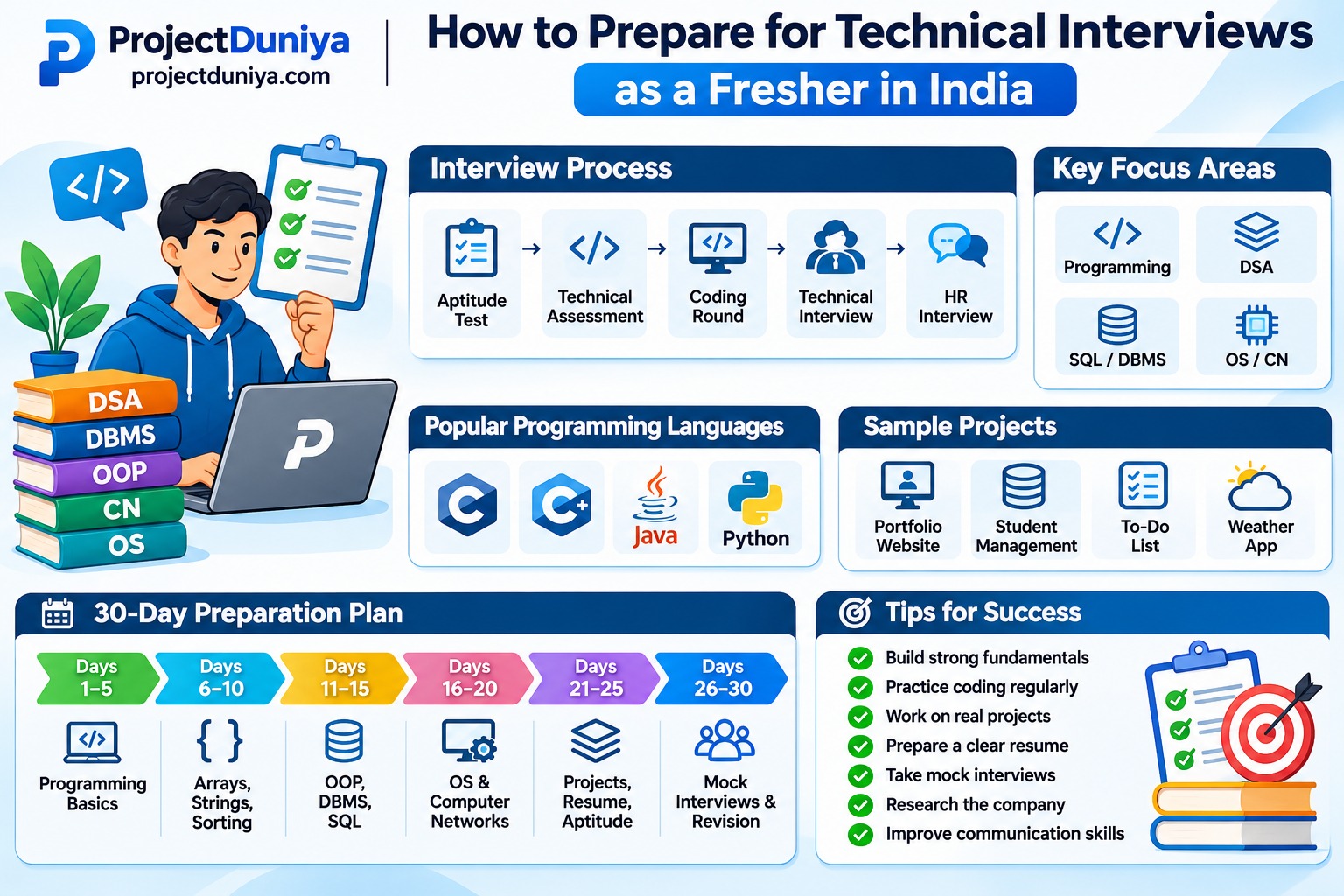
- Aptitude Test: Tests logical reasoning, quantitative aptitude, and verbal ability.
- Technical Assessment: Checks programming fundamentals and technical knowledge.
- Coding Round: Evaluates problem-solving and coding skills.
- Technical Interview: Covers programming, DSA, projects, and computer science subjects.
- HR Interview: Evaluates communication, attitude, and career goals.
2. Choose One Programming Language
Start by selecting one programming language and learning it properly. Avoid switching between multiple languages during the initial preparation stage.
Popular programming languages for freshers include:
- C: Useful for understanding programming fundamentals.
- C++: Popular for data structures and algorithms.
- Java: Widely used in enterprise and backend development.
- Python: Beginner-friendly and useful for development and automation.
Important Topics to Learn
- Variables and data types.
- Operators and expressions.
- Conditional statements.
- Loops and functions.
- Arrays and strings.
- Object-oriented programming.
- Exception handling.
- Basic input and output operations.
3. Learn Data Structures and Algorithms (DSA)
Data Structures and Algorithms are important for software development interviews. They help interviewers understand how you approach problems and write efficient solutions.
Important DSA Topics
- Arrays: Searching, sorting, reversing, and finding duplicate elements.
- Strings: Palindrome checking, anagrams, and character frequency.
- Linked Lists: Insertion, deletion, and traversal.
- Stacks: Push, pop, and balanced parentheses.
- Queues: Basic queue operations and applications.
- Searching: Linear search and binary search.
- Sorting: Bubble sort, selection sort, insertion sort, and merge sort.
- Trees: Basic tree concepts and traversals.
- Hashing: Hash maps, sets, and frequency counting.
- Complexity: Time and space complexity.
Example Coding Questions
- Reverse a string.
- Find the largest and second-largest number in an array.
- Check whether a number is prime.
- Check whether a string is a palindrome.
- Find duplicate elements in an array.
- Find the factorial of a number.
- Print the Fibonacci series.
4. Prepare Core Computer Science Subjects
Many technical interviews include questions from fundamental computer science subjects. Focus on understanding concepts and practical examples rather than memorizing definitions.
Database Management System (DBMS)
- What is DBMS and RDBMS?
- Primary key and foreign key.
- SQL commands: DDL, DML, DCL, and TCL.
- Joins and subqueries.
- Normalization.
- ACID properties and transactions.
Object-Oriented Programming (OOP)
- Classes and objects.
- Inheritance.
- Polymorphism.
- Encapsulation.
- Abstraction.
- Constructors and method overloading.
Operating Systems (OS)
- Process and thread.
- Multitasking and multiprocessing.
- Deadlock and its conditions.
- Memory management.
- CPU scheduling.
Computer Networks (CN)
- OSI and TCP/IP models.
- TCP vs UDP.
- HTTP and HTTPS.
- IP address and DNS.
- Client-server architecture.
5. Practice SQL Queries
SQL is commonly asked in interviews for software development, testing, data-related, and database roles. Practice writing queries instead of learning only theoretical concepts.
Example SQL Questions
-- Display all employees
SELECT * FROM employees;

-- Find employees with salary greater than 30000
SELECT * FROM employees
WHERE salary > 30000;

-- Sort employees by salary
SELECT * FROM employees
ORDER BY salary DESC;

-- Count total employees
SELECT COUNT(*) FROM employees;

-- Find the highest salary
SELECT MAX(salary) FROM employees;
6. Build Practical Projects
Projects help demonstrate your practical knowledge. As a fresher, try to build two or three useful projects instead of adding many incomplete projects to your resume.
Beginner Project Ideas
- Portfolio Website: Display your skills, education, projects, and contact details.
- Student Management System: Manage student records and academic information.
- To-Do List: Create, update, and delete daily tasks.
- Weather Application: Display weather information using an API.
- Library Management System: Manage books, users, and issue records.
Be Ready to Explain Your Projects
- What problem does your project solve?
- Which technologies did you use?
- What was your role in developing it?
- What challenges did you face?
- How does the application work?
- What improvements can you make in the future?
7. Create a Professional Resume
Your resume creates the first impression during the recruitment process. Keep it simple, clear, and focused on the job role.
Important Resume Sections
- Name and contact information.
- Career objective or professional summary.
- Technical skills.
- Educational qualifications.
- Academic and personal projects.
- Internships and certifications, if available.
- Achievements, if relevant.
Mention only the skills and projects you can confidently explain. Check your resume for spelling mistakes and keep the formatting consistent.
8. Prepare for Aptitude and Logical Reasoning
Many Indian IT companies conduct aptitude tests as part of their initial selection process. Regular practice can improve both speed and accuracy.
Quantitative Aptitude
- Percentages and averages.
- Profit and loss.
- Time and work.
- Time, speed, and distance.
- Simple and compound interest.
- Ratio and proportion.
Logical Reasoning
- Number series.
- Blood relations.
- Direction sense.
- Coding-decoding.
- Puzzles and seating arrangements.
Verbal Ability
- Grammar and sentence correction.
- Reading comprehension.
- Vocabulary.
- Sentence completion.
9. Improve Communication Skills
Technical knowledge is important, but you should also be able to explain your ideas clearly. Interviewers want to understand your thought process and how you communicate with others.
- Practice introducing yourself in one or two minutes.
- Explain technical concepts using simple language.
- Speak clearly and avoid rushing your answers.
- Listen carefully before answering questions.
- If you do not know an answer, be honest and explain what you understand.
- Practice speaking in English if the job requires it.
10. Prepare Common HR Interview Questions
Prepare genuine and structured answers for frequently asked HR questions.
- Tell me about yourself: Briefly explain your education, skills, projects, and career interests.
- Why should we hire you? Highlight your skills, learning ability, and willingness to contribute.
- What are your strengths? Mention relevant strengths with examples.
- What are your weaknesses? Share an area you are actively working to improve.
- Why do you want to join our company? Explain your interest in the role and company.
- Where do you see yourself in five years? Discuss realistic professional growth goals.
- Are you comfortable relocating? Answer honestly based on your situation.
11. Research the Company Before the Interview
Before attending an interview, spend some time understanding the company and the position you applied for.
- Visit the official company website.
- Understand the company’s products and services.
- Read the job description carefully.
- Identify the technical skills required for the role.
- Prepare questions about the team and responsibilities.
- Review the company’s recruitment process when reliable information is available.
12. Practice Mock Interviews
Mock interviews help you understand how you perform under interview conditions. They also help identify areas that need improvement.
- Practice with friends, classmates, or mentors.
- Attempt timed coding questions.
- Explain your approach before writing code.
- Practice technical and HR questions.
- Review mistakes after every mock interview.
- Work on confidence and clear communication.
13. Use Helpful Online Learning Platforms
You can use free and paid online platforms to improve your technical and interview preparation.
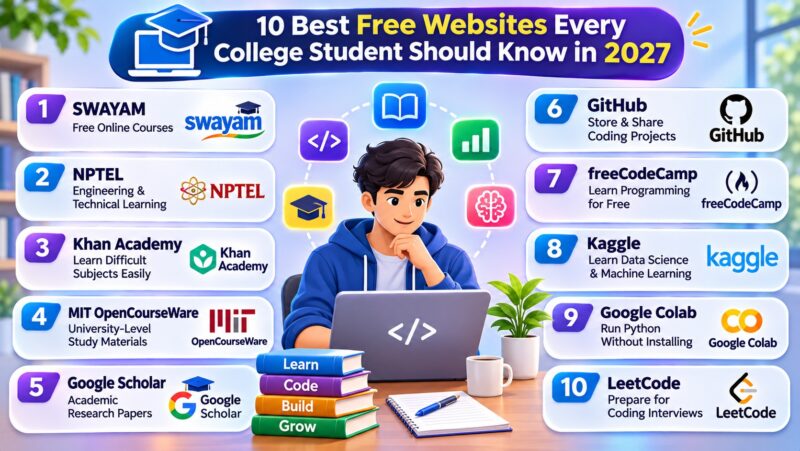
- LeetCode: Coding problems and DSA practice.
- HackerRank: Programming challenges and skill assessments.
- GeeksforGeeks: Technical articles and interview questions.
- IndiaBix: Aptitude and reasoning practice.
- GitHub: Project hosting and code management.
- freeCodeCamp: Programming and web development tutorials.
- NPTEL: Academic courses in computer science and engineering.
14. Follow a 30-Day Interview Preparation Plan
A structured timetable helps you cover important topics without wasting time. Adjust the schedule according to your current knowledge and available preparation time.
| Days | Topics to Cover | Daily Practice |
|---|---|---|
| 1–5 | Programming fundamentals and basic concepts | Write simple programs and solve basic problems |
| 6–10 | Arrays, strings, searching, and sorting | Solve coding questions |
| 11–15 | OOP, DBMS, and SQL | Revise concepts and write SQL queries |
| 16–20 | Operating systems and computer networks | Practice interview questions |
| 21–25 | Projects, resume, and aptitude | Improve projects and solve aptitude questions |
| 26–30 | Mock interviews and revision | Attempt mock tests and revise weak topics |
15. Common Mistakes Freshers Should Avoid
- Learning without practice: Watching tutorials alone will not improve your coding skills.
- Memorizing answers: Understand concepts instead of remembering fixed answers.
- Ignoring DSA: Practice basic problem-solving regularly.
- Adding fake skills: Never mention technologies you cannot explain.
- Ignoring projects: Build practical projects to demonstrate your knowledge.
- Not researching companies: Understand the role before attending an interview.
- Giving up after rejection: Learn from feedback and continue preparing.
16. Frequently Asked Questions (FAQs)
Q1. Can I get a software job as a fresher without work experience?
Yes. Many companies recruit fresh graduates for entry-level roles. You can demonstrate your abilities through programming skills, projects, internships, and academic experience.
Q2. Which programming language is best for freshers?
Java, Python, C++, and C are all useful. Choose one based on your career goals and learn its fundamentals thoroughly.
Q3. Is DSA compulsory for every technical interview?
Not every role requires advanced DSA, but basic data structures and problem-solving are important for many software development interviews.
Q4. How many projects should a fresher include in a resume?
Two or three good projects are generally sufficient. Focus on explaining the features, technologies, and your contribution clearly.
Q5. How many hours should I study daily?
Try to study consistently for two to four focused hours, depending on your schedule. Give time to coding, theory, and revision.
Q6. Can I prepare for technical interviews in 30 days?
You can revise fundamentals and prepare for basic interviews in 30 days. However, building strong coding and technical skills may require more time.
Q7. What should I do if I cannot answer an interview question?
Stay calm, explain what you know, and try to reason through the problem. Avoid guessing or pretending to know something you do not understand.
Conclusion
Preparing for technical interviews as a fresher is a gradual process. Focus on programming fundamentals, data structures and algorithms, core computer science subjects, SQL, and practical projects. Along with technical knowledge, improve your communication skills and practice explaining your solutions clearly.
Follow a consistent study plan, solve coding problems regularly, and take mock interviews to identify your weak areas. Do not compare your progress with others or lose confidence after rejection. Every interview is an opportunity to learn and improve.
Stay consistent, keep learning, and prepare with confidence. Your first IT job becomes more achievable when you build the right skills and practice regularly.