Choosing a final-year project is one of the most important decisions for computer science students. A good project allows you to apply programming knowledge, understand real-world problems, develop technical skills, and demonstrate your abilities during academic evaluations and job interviews.
However, selecting the right topic can be challenging. Some projects are too basic, while others require advanced technologies, expensive hardware, or more development time than students have available.
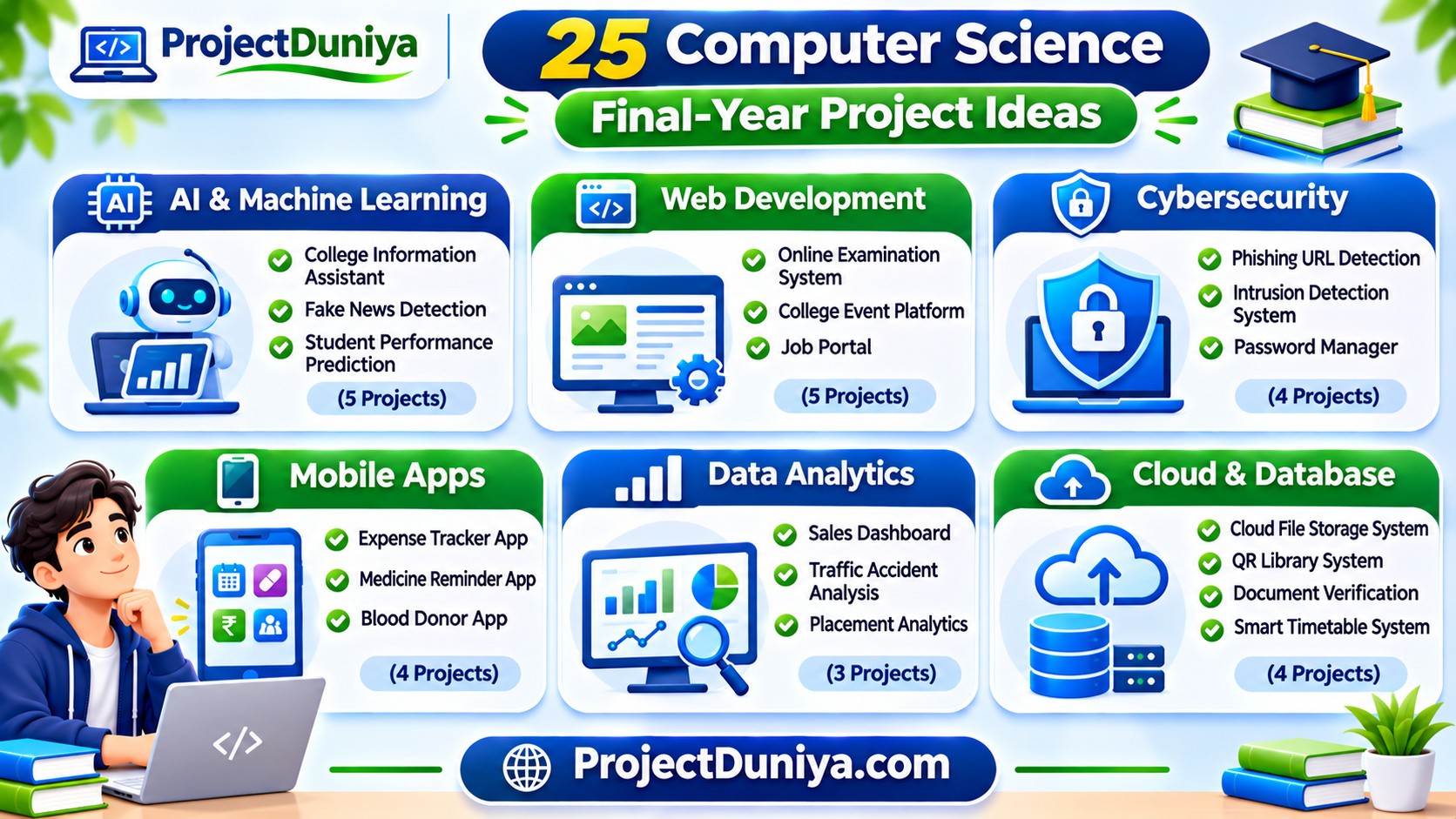
In this guide, you will discover 25 computer science project ideas for final-year students, covering artificial intelligence, web development, cybersecurity, mobile applications, cloud computing, and data analytics. Each idea includes a short description, suggested technologies, and difficulty level to help you choose a suitable project.
1. Artificial Intelligence and Machine Learning Projects
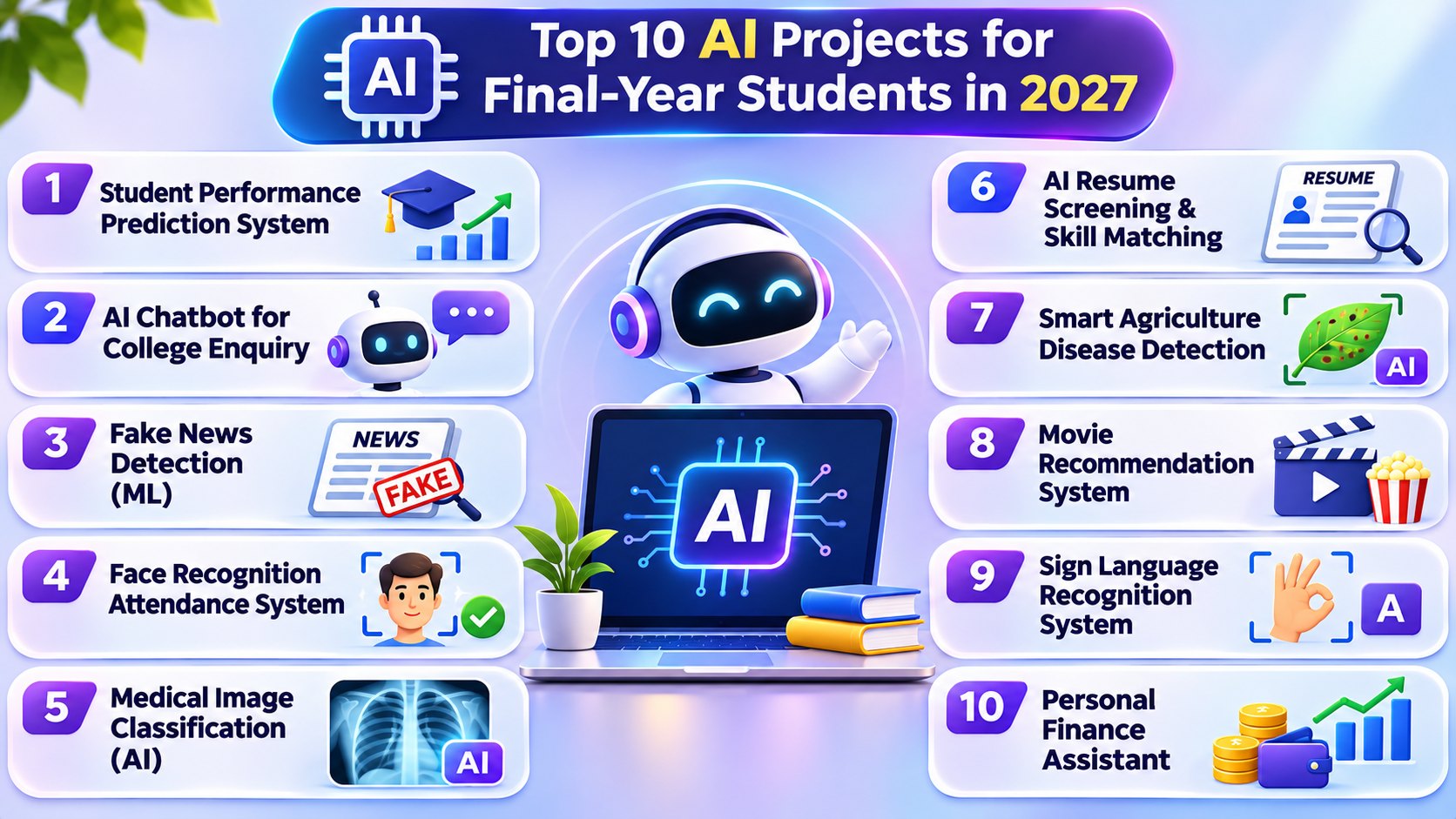
AI and machine learning projects allow students to build applications that identify patterns, classify information, generate predictions, or assist users with specific tasks.
1. AI-Powered College Information Assistant
Build a chatbot that answers questions about college admissions, courses, examination rules, fees, and academic schedules. The system can retrieve answers from approved college documents instead of relying only on predefined responses.
Technologies: Python, FastAPI, an LLM API, vector database, HTML, CSS, JavaScript.
Difficulty: Intermediate to Advanced.
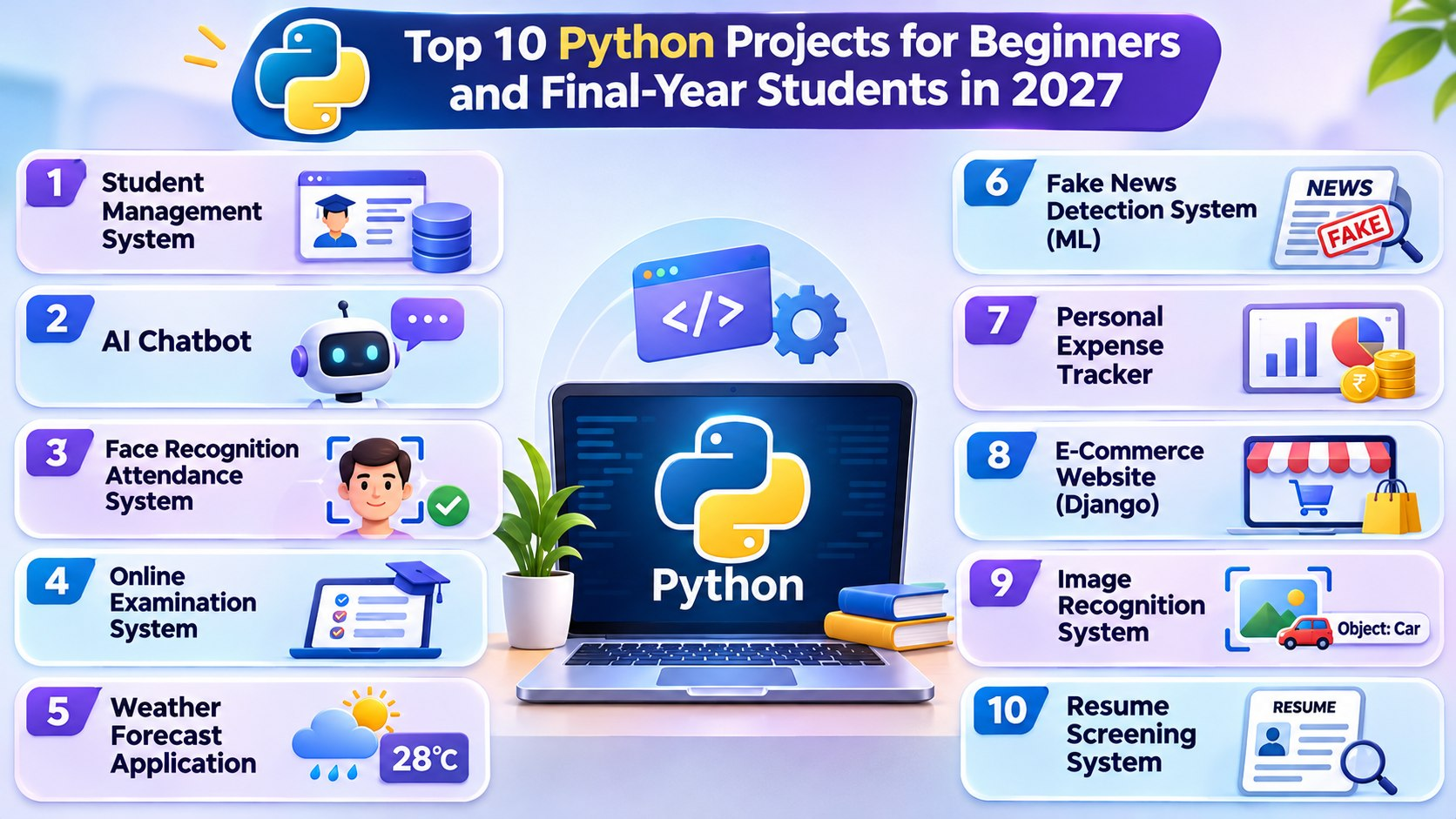
2. Fake News Detection System
Develop a system that analyzes submitted news text and predicts whether it resembles misleading or reliable content based on its training data. Display the prediction and explain that automated classification cannot independently verify every claim.
Technologies: Python, NLP, Pandas, Scikit-learn, Flask.
Difficulty: Intermediate.
3. Student Performance Prediction System
Create an application that analyzes historical academic information, such as attendance, assignment completion, and examination results, to identify patterns associated with student performance.
Technologies: Python, Scikit-learn, Pandas, MySQL, Streamlit.
Difficulty: Intermediate.
4. Resume Screening and Job Matching System
Build a tool that compares resumes with job descriptions and identifies relevant skills, qualifications, and experience. Include transparent matching criteria and allow users to review the results rather than treating automated rankings as final hiring decisions.
Technologies: Python, NLP, Flask, PostgreSQL.
Difficulty: Intermediate to Advanced.
5. Plant Disease Detection Application
Develop an image classification application that identifies selected plant diseases from leaf photographs. Users upload an image and receive a predicted category with an explanation of the model’s limitations.
Technologies: Python, TensorFlow or PyTorch, OpenCV, Flask.
Difficulty: Advanced.
2. Web Development Projects
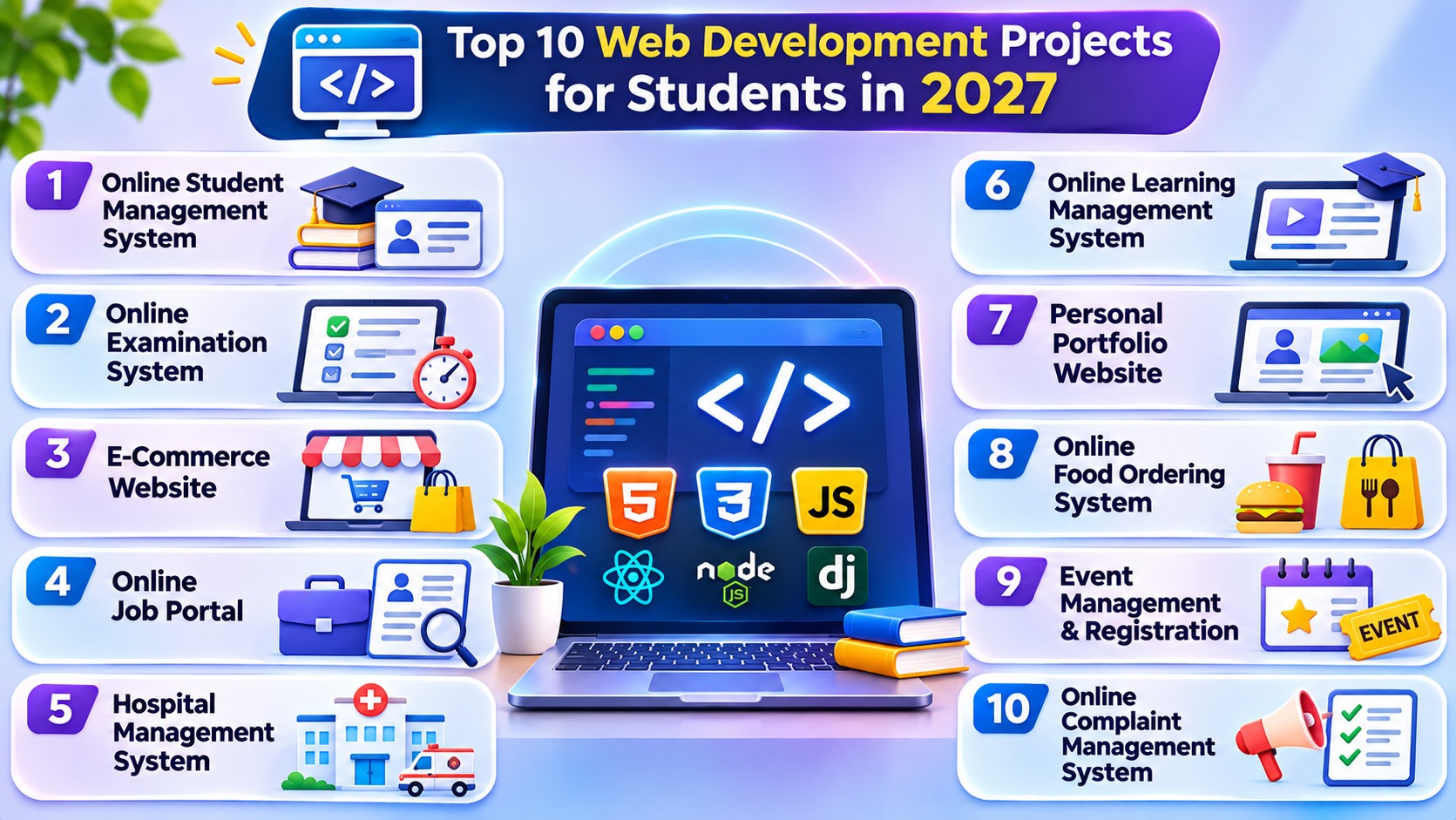
Web development projects are suitable for students who want to demonstrate frontend design, backend programming, database management, authentication, and application deployment skills.
6. Online Examination and Assessment System
Create a web application where administrators can add questions, students can take timed examinations, and results are calculated automatically. Include question management, student accounts, and an examination history.
Technologies: HTML, CSS, JavaScript, React, Node.js, MySQL.
Difficulty: Intermediate.
7. Smart College Event Management Platform
Develop a platform where students can discover college events, register for activities, receive announcements, and view event schedules. Administrators can manage registrations and attendance.
Technologies: React, Node.js, Express.js, MongoDB.
Difficulty: Intermediate.
8. Online Job Portal for Students
Build a job portal that connects students and fresh graduates with internship and employment opportunities. Include profile creation, job posting, application tracking, and search filters.
Technologies: React, Django or Node.js, PostgreSQL.
Difficulty: Intermediate.
9. Collaborative Study Platform
Create a platform where students can form study groups, share learning resources, organize discussions, and collaborate on academic tasks. Add role-based access and group management features.
Technologies: Next.js, Firebase or Supabase, JavaScript.
Difficulty: Intermediate.
10. Lost and Found Management System
Develop a college-based application where students can report lost items, upload photographs, browse found objects, and contact the person who submitted a matching listing.
Technologies: HTML, CSS, JavaScript, PHP or Node.js, MySQL.
Difficulty: Beginner to Intermediate.
3. Cybersecurity and Network Security Projects
Cybersecurity projects help students understand authentication, network monitoring, secure data storage, and common security threats. Build and test these systems only in authorized environments.
11. Phishing URL Detection System
Create a tool that examines website addresses and identifies characteristics commonly associated with phishing URLs. It can use a machine learning model trained on labeled URL datasets.
Technologies: Python, Scikit-learn, Flask, HTML, CSS.
Difficulty: Intermediate.
12. Network Intrusion Detection System
Build a system that analyzes network traffic records and identifies patterns associated with suspicious activity. Use a public cybersecurity dataset or traffic generated in your own isolated lab.
Technologies: Python, Scikit-learn, Pandas, Wireshark.
Difficulty: Advanced.
13. Secure Password Manager
Develop a password manager that stores user credentials in encrypted form. Include a master password, secure key derivation, automatic locking, and password-strength guidance.
Technologies: Python or JavaScript, SQLite, cryptography libraries.
Difficulty: Intermediate to Advanced.
14. Secure File Sharing Application
Create a platform that allows authenticated users to upload and share files using controlled access permissions. Add expiring download links, file-size restrictions, and activity logs.
Technologies: Node.js, Express.js, PostgreSQL, cloud object storage.
Difficulty: Intermediate.
4. Mobile Application Development Projects
Mobile applications are useful final-year projects because they demonstrate interface design, API integration, data storage, and user-focused development.
15. Personal Expense Tracker App
Develop an application that allows users to record income, expenses, categories, and monthly budgets. Include charts to show spending patterns and help users review their financial habits.
Technologies: Flutter, Dart, Firebase.
Difficulty: Beginner to Intermediate.
16. Medicine Reminder Application
Build an application where users can enter medicine schedules and receive reminders. Include configurable notifications, reminder history, and an option to mark a reminder as completed.
Technologies: Flutter, SQLite, Firebase Cloud Messaging.
Difficulty: Intermediate.
17. Blood Donor Connection App
Create a platform that connects registered volunteer blood donors with people searching for donors. Add blood-group filters, location-based discovery, and contact options while protecting personal information.
Technologies: React Native or Flutter, Firebase, Maps API.
Difficulty: Intermediate.
18. Smart Attendance Management App
Develop a mobile application that helps teachers record attendance and allows students to view their attendance history. Add secure login, class management, and attendance reports.
Technologies: Flutter, Firebase, Cloud Firestore.
Difficulty: Intermediate.
5. Data Science and Analytics Projects
Data analytics projects focus on collecting, cleaning, analyzing, and presenting information. They are suitable for students interested in data analyst, business intelligence, and data science roles.
19. Sales Analytics Dashboard
Build an interactive dashboard that displays revenue, product performance, monthly trends, and regional sales. Allow users to filter results by date, category, and location.
Technologies: Python, Pandas, Power BI, SQL.
Difficulty: Beginner to Intermediate.
20. Traffic Accident Analysis System
Analyze publicly available traffic accident data to identify patterns by location, time, weather conditions, and accident type. Present the findings through charts and maps.
Technologies: Python, Pandas, GeoPandas, Folium, Matplotlib.
Difficulty: Intermediate.
21. Student Placement Analytics System
Create a dashboard that analyzes placement information, including department-wise placement rates, job roles, skill requirements, and salary distributions where reliable data is available.
Technologies: SQL, Python, Power BI, Excel.
Difficulty: Beginner to Intermediate.
6. Cloud Computing and Database Projects
Cloud and database projects help students understand how applications store, process, and manage information across different services.
22. Cloud-Based File Storage System
Develop an application where users can upload, download, organize, and share files through cloud storage. Include authentication, file permissions, and storage usage information.
Technologies: Python, Flask, AWS S3 or compatible object storage, MySQL.
Difficulty: Intermediate.
23. Library Management System with QR Codes
Build a library application that manages books, student accounts, borrowing records, and return dates. QR codes can help identify books and simplify issue and return operations.
Technologies: Java or Python, MySQL, QR code library, HTML, CSS.
Difficulty: Beginner to Intermediate.
24. Student Document Verification Platform
Create a system where institutions can issue digital certificates with unique verification codes. Employers or other authorized users can check whether a certificate record matches the institution’s stored information.
Technologies: React, Node.js, PostgreSQL, QR codes.
Difficulty: Intermediate.
25. Smart Timetable Generator
Develop an application that generates class timetables based on teacher availability, classroom capacity, subject requirements, and scheduling constraints. The system should identify conflicts and produce a suitable timetable.
Technologies: Python, Django, Google OR-Tools, PostgreSQL.
Difficulty: Intermediate to Advanced.
7. Comparison of Computer Science Final-Year Project Ideas
Use this table to shortlist projects according to your interests and technical experience.
| Project | Domain | Difficulty |
|---|---|---|
| College Information Assistant | AI | Intermediate–Advanced |
| Fake News Detection | Machine Learning | Intermediate |
| Online Examination System | Web Development | Intermediate |
| College Event Platform | Web Development | Intermediate |
| Phishing URL Detection | Cybersecurity | Intermediate |
| Secure Password Manager | Cybersecurity | Intermediate–Advanced |
| Expense Tracker App | Mobile Development | Beginner–Intermediate |
| Blood Donor App | Mobile Development | Intermediate |
| Sales Analytics Dashboard | Data Analytics | Beginner–Intermediate |
| Cloud File Storage | Cloud Computing | Intermediate |
| Smart Timetable Generator | Algorithms | Intermediate–Advanced |
8. How to Choose the Best Final-Year Project
Selecting a project should involve more than choosing a popular technology. Consider the following factors before finalizing your topic:
- Your technical skills: Choose a project that matches your knowledge of programming languages, databases, and frameworks.
- Problem relevance: Identify a real problem that your project can solve or improve.
- Development time: Make sure the main features can be completed within your academic schedule.
- Data availability: Confirm that you can access the datasets, APIs, or hardware required.
- Project demonstration: Select an idea that you can demonstrate clearly to your project guide and evaluation panel.
- Scope for improvement: Leave room for additional features without making the initial version too complicated.
9. Steps to Complete Your Final-Year Project Successfully
After selecting your topic, divide the work into manageable stages.
- Define the problem: Explain what issue your project addresses and who will use the solution.
- Prepare the project synopsis: Write the objectives, proposed solution, scope, and expected outcome.
- Research existing systems: Study similar applications and identify what your project will improve.
- Design the system: Prepare flowcharts, database diagrams, architecture diagrams, and interface layouts.
- Develop the core features: Build the essential functions before adding optional features.
- Test the application: Check functionality, input validation, security, and performance.
- Prepare documentation: Include the methodology, implementation details, screenshots, results, and limitations.
- Practice your viva: Prepare to explain the problem, technology choices, architecture, and important code sections.
10. What Makes a Final-Year Project Stand Out?
A strong final-year project should demonstrate more than a collection of features. It should show that you understand the problem, made appropriate technical decisions, and tested whether your solution works.
Consider adding these elements:
- A clear problem statement and measurable objectives.
- A working application or prototype.
- Proper database design and input validation.
- Relevant test cases and documented results.
- A comparison with an existing approach where appropriate.
- Clear project documentation and a demonstration video.
- An honest explanation of limitations and possible future improvements.
Conclusion
Computer science offers many opportunities for final-year projects, from AI-powered applications and web platforms to cybersecurity tools, mobile apps, and data analytics systems. The best choice depends on your skills, available resources, academic requirements, and the time you have to complete the work.
Before finalizing a topic, define its core features, confirm that the required tools and data are available, and discuss the scope with your project guide. Focus on building a working solution that you can test, demonstrate, and explain confidently.
For more computer science project guidance, academic resources, and development support, visit ProjectDuniya.