Machine learning and deep learning are two important technologies behind many modern artificial intelligence applications. They are used in areas such as recommendation systems, image recognition, voice assistants, fraud detection, and language processing.
Although these terms are closely related, they do not mean exactly the same thing. Machine learning is a broad area of AI that allows computers to learn patterns from data. Deep learning is a specialized part of machine learning that uses multi-layered neural networks to learn more complex patterns.
Understanding the difference is useful for students who are studying computer science, planning AI projects, or exploring careers in artificial intelligence. This guide explains both technologies with simple examples, a comparison table, and a beginner learning roadmap.
1. What Is Machine Learning?
Machine learning (ML) is a branch of artificial intelligence that enables computer systems to learn from data and make predictions or decisions without being explicitly programmed with every rule.
Instead of writing instructions for every possible situation, developers provide data and use an algorithm to identify patterns. The trained model can then use those patterns to make predictions on new data.
For example, imagine creating an email spam detector. You provide a machine learning model with examples of spam and legitimate emails. The model learns patterns associated with each category and uses them to classify new messages.
Common Machine Learning Types
- Supervised Learning: The model learns from labeled examples, such as emails marked as spam or not spam.
- Unsupervised Learning: The model identifies patterns or groups in data without predefined labels.
- Reinforcement Learning: An agent learns through actions, feedback, rewards, and penalties in an environment.
2. What Is Deep Learning?
Deep learning is a specialized area of machine learning that uses artificial neural networks containing multiple layers. These networks learn representations and patterns from data through a training process.
Deep learning is particularly useful when working with complex information such as images, audio, video, and natural language.
For example, an image recognition system can be trained using many labeled pictures of cats and dogs. A deep learning model can learn visual features such as shapes, textures, and patterns to distinguish between the two categories.
Common Deep Learning Architectures
- Artificial Neural Networks (ANNs): Networks of connected computational units that learn patterns from data.
- Convolutional Neural Networks (CNNs): Commonly used for image processing and visual recognition tasks.
- Recurrent Neural Networks (RNNs): Designed to process sequential information, although newer architectures are often preferred for many modern applications.
- Transformers: Architectures widely used in language models and other applications involving complex sequences.
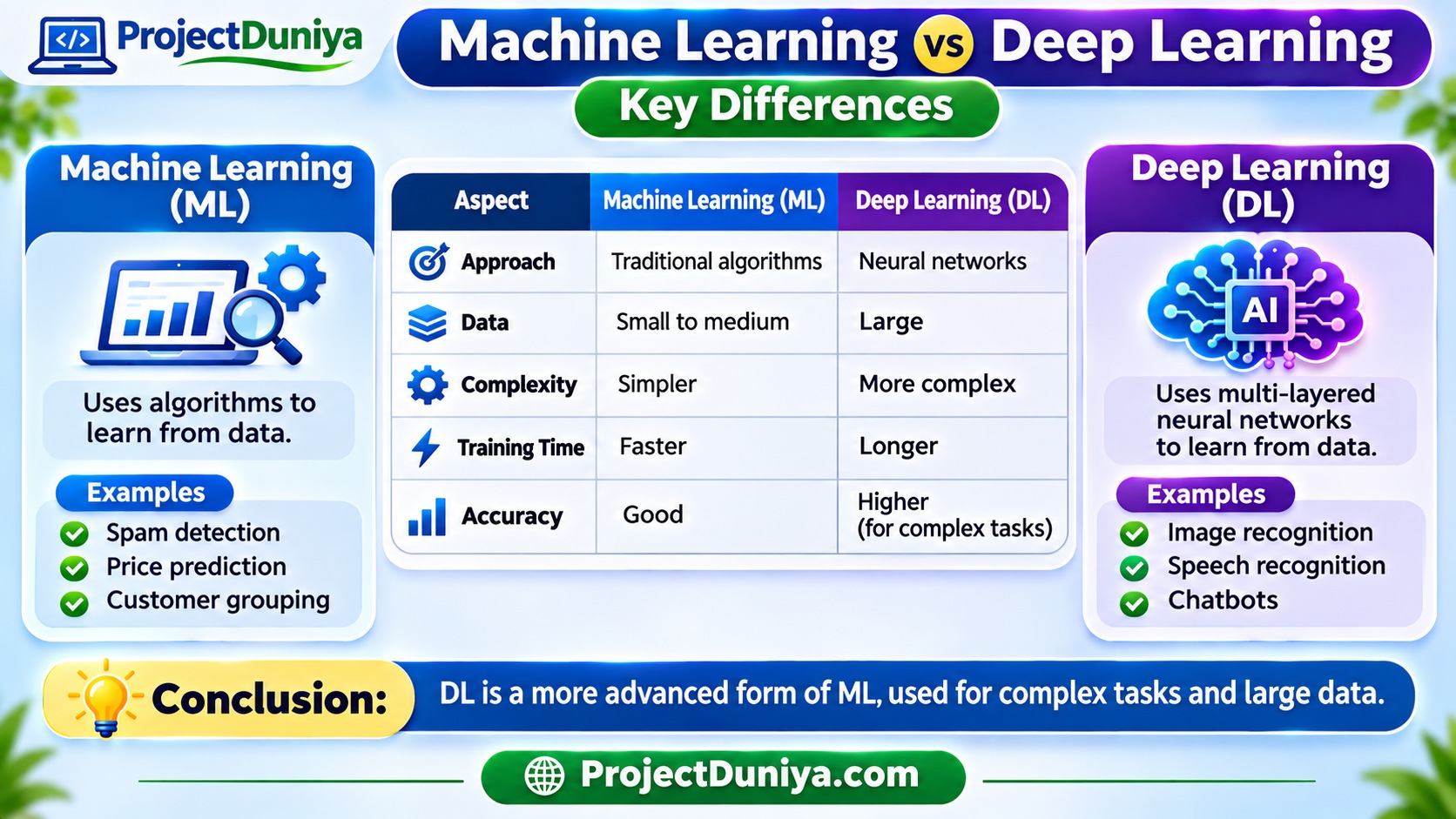
3. Machine Learning vs Deep Learning: Key Differences
Both technologies learn from data, but they differ in their methods, resource requirements, and typical applications.
| Comparison | Machine Learning | Deep Learning |
|---|---|---|
| Meaning | A broad field of algorithms that learn patterns from data. | A specialized part of ML based on multi-layered neural networks. |
| Data Requirements | Can work with smaller datasets for suitable problems. | Often benefits from large datasets, depending on the task. |
| Feature Extraction | May require humans to select or design useful features. | Can learn useful features automatically during training. |
| Computing Resources | Many algorithms can run on standard computers. | Complex models may require powerful GPUs or specialized hardware. |
| Training Time | Often shorter for simpler models and datasets. | Can take longer, particularly for large models. |
| Interpretability | Some models are relatively easy to explain. | Complex neural networks can be harder to interpret. |
| Typical Uses | Prediction, classification, and customer analysis. | Image recognition, speech processing, and advanced language tasks. |
4. Real-World Applications of Machine Learning
Machine learning is used across different industries to identify patterns, automate predictions, and support decision-making.
- Banking: Detecting potentially fraudulent transactions.
- E-commerce: Recommending products based on customer activity.
- Healthcare: Supporting analysis of medical data and risk prediction.
- Education: Analyzing learning patterns and supporting personalized learning systems.
- Business: Forecasting sales and analyzing customer behavior.
5. Real-World Applications of Deep Learning
Deep learning is useful for tasks involving complex data, particularly when traditional feature extraction methods are less effective.
- Image Recognition: Identifying objects, faces, and visual patterns in images.
- Speech Recognition: Converting spoken language into text.
- Natural Language Processing: Supporting translation, text generation, and language understanding.
- Autonomous Systems: Helping machines interpret information from cameras and other sensors.
- Medical Imaging: Assisting with the analysis of certain types of medical scans.
6. Which Should Beginners Learn First?
For most students who are new to artificial intelligence, starting with machine learning fundamentals is a practical approach. Understanding data, algorithms, and model evaluation makes it easier to study deep learning later.
A beginner-friendly learning sequence is:
- Learn Python: Understand variables, loops, functions, lists, and basic programming concepts.
- Study Mathematics: Build basic knowledge of statistics, probability, linear algebra, and relevant calculus concepts.
- Practice Data Handling: Learn how to work with datasets using tools such as NumPy and pandas.
- Study Machine Learning: Explore regression, classification, clustering, and model evaluation.
- Learn Deep Learning: Understand neural networks and experiment with a framework such as PyTorch or TensorFlow.
- Build Projects: Apply your knowledge to practical problems and document your results.
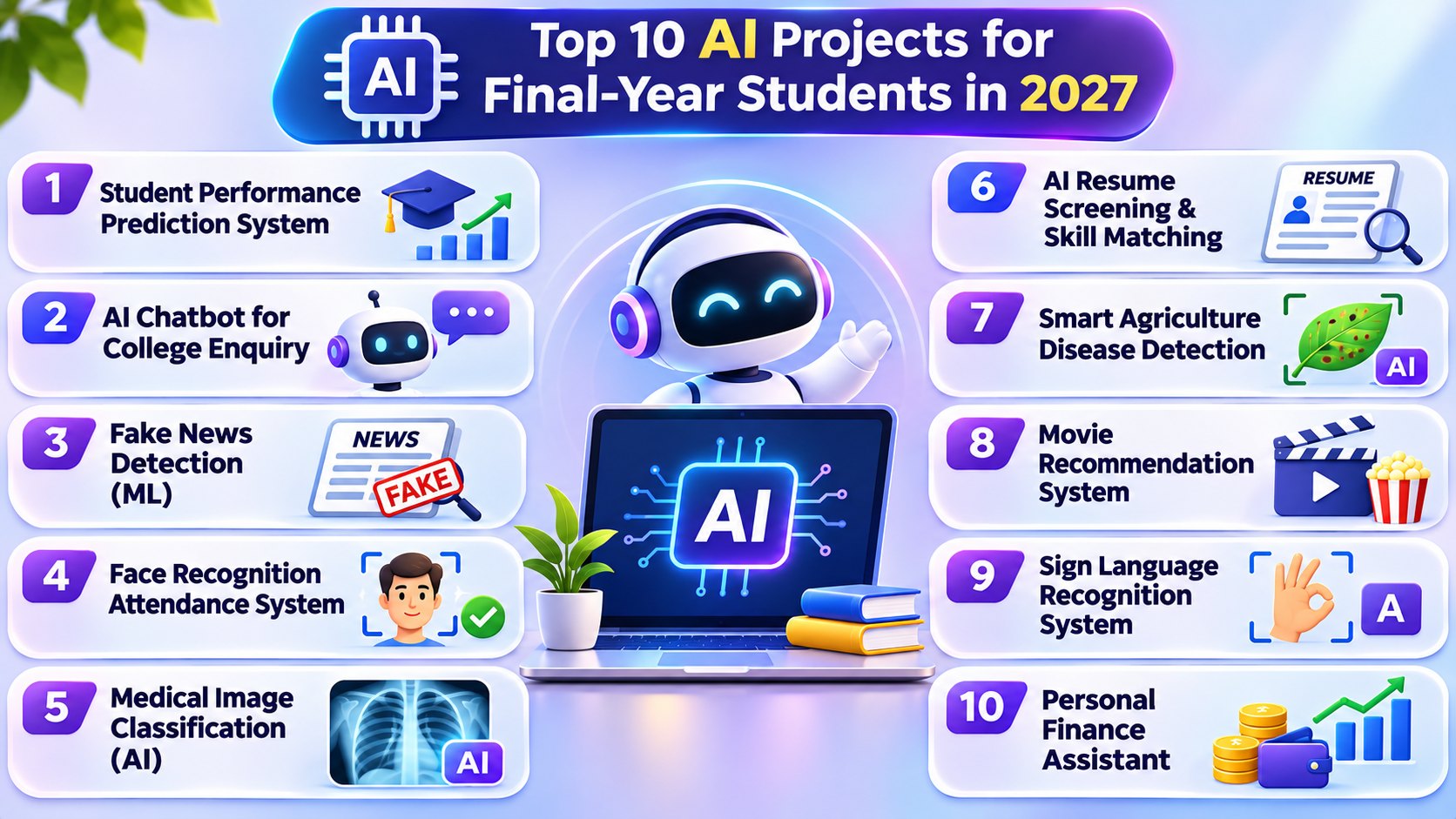
7. Project Ideas for Machine Learning and Deep Learning
Practical projects can help students understand how these technologies work. Start with a manageable problem and gradually increase its complexity.
| Project | Technology | Concept Demonstrated |
|---|---|---|
| Student Performance Prediction | Machine Learning | Regression and data analysis. |
| Email Spam Classification | Machine Learning | Text classification. |
| Customer Segmentation | Machine Learning | Clustering and pattern discovery. |
| Handwritten Digit Recognition | Deep Learning | Neural networks and image classification. |
| Plant Disease Image Classification | Deep Learning | Image recognition using neural networks. |
When building a project, explain the dataset, preprocessing steps, model selection, evaluation method, and limitations. This makes your work more useful for academic submissions and technical interviews.
8. Career Opportunities in Machine Learning and Deep Learning
Students who develop strong skills in AI and data technologies can explore several career paths. Job titles and requirements vary between employers, and many entry-level positions expect a combination of programming, mathematics, and practical experience.
- Machine Learning Engineer: Develops and deploys machine learning systems.
- Data Scientist: Uses data analysis, statistics, and modeling to solve business or research problems.
- AI Engineer: Builds applications that use artificial intelligence technologies.
- Deep Learning Engineer: Works with neural network models and related systems.
- Research Assistant: Supports academic or industrial research projects in AI and related fields.
Focus on building a strong foundation before choosing a specialization. A portfolio of well-documented projects can help demonstrate your practical abilities.
Conclusion
Machine learning and deep learning are closely connected technologies that help computers learn from data. Machine learning includes a wide range of algorithms, while deep learning uses multi-layered neural networks to solve problems involving complex patterns.
If you are a beginner, start with Python, mathematics, data handling, and basic machine learning algorithms. Once you understand these concepts, move on to neural networks and deep learning frameworks. Consistent practice and practical projects will help you develop the knowledge needed for further study and AI-related careers.
Explore ProjectDuniya for more student learning resources, programming tutorials, and technology guidance.