Python is one of the most popular programming languages among students because of its simple syntax, powerful libraries, and wide range of applications. From web development and automation to Artificial Intelligence and Machine Learning, Python provides many opportunities to build useful software projects.
For students pursuing B.Tech, BCA, MCA, Diploma, or other computer science courses, developing Python projects is an excellent way to improve programming skills and gain practical experience. If you are searching for interesting Python project ideas for 2027, this article covers ten useful projects suitable for beginners as well as final-year students.
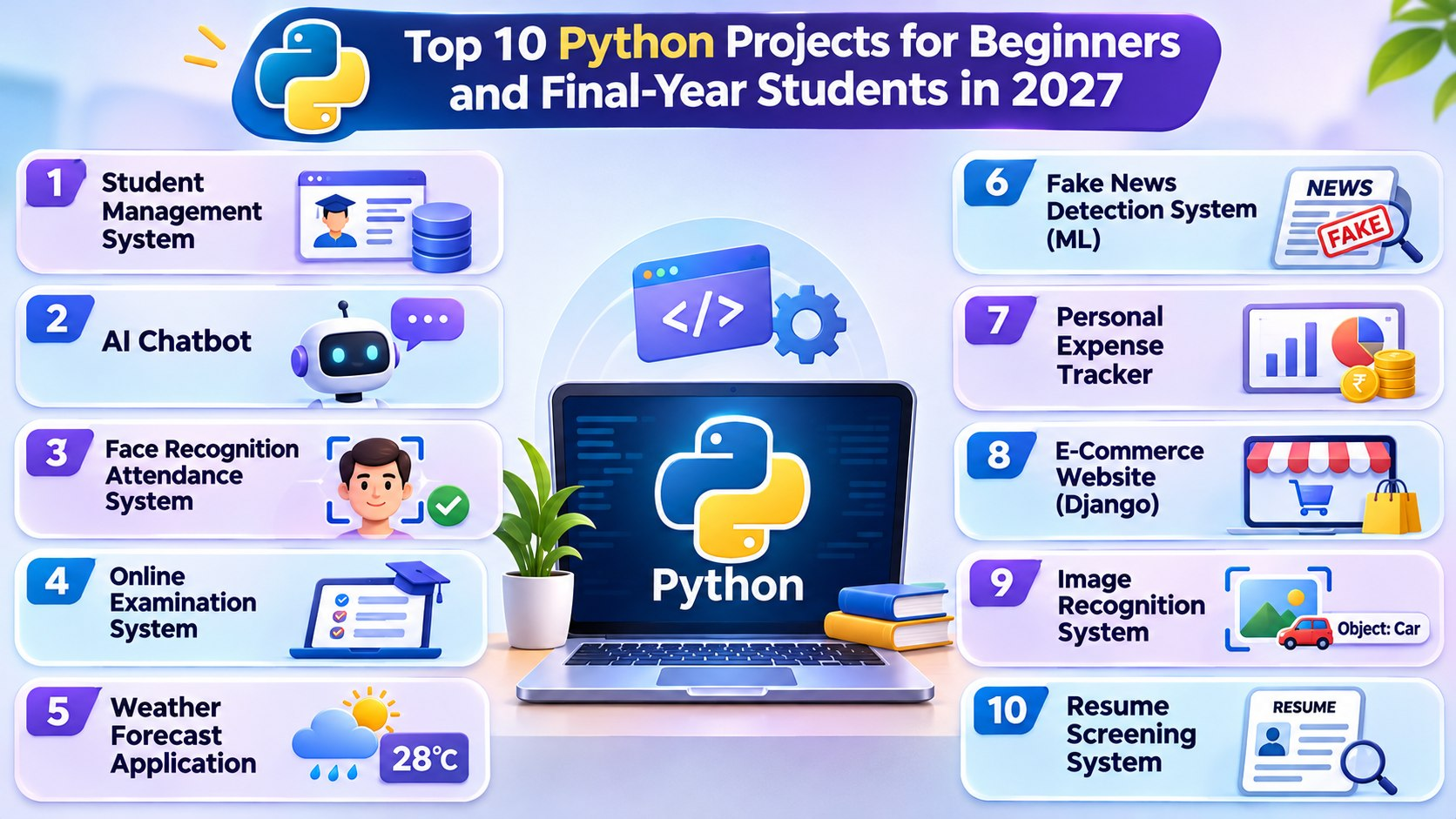
1. Student Management System Using Python
A Student Management System is a useful beginner-level project for learning how to manage and store information using Python. It helps educational institutions maintain student records in an organized way.
Key Features:
- Add, update, and delete student records.
- Store names, roll numbers, courses, and contact details.
- Search for students using their roll numbers.
- Display student information in an organized format.
Technologies: Python, SQLite or MySQL, and Tkinter.
2. AI Chatbot Using Python
An AI Chatbot is an interesting project for students who want to explore Artificial Intelligence and Natural Language Processing. The chatbot can interact with users and provide answers to common questions.
Key Features:
- Respond to frequently asked questions.
- Understand basic user messages.
- Provide automated information and assistance.
- Maintain a simple conversation history.
Technologies: Python, NLP libraries, Flask, and an AI API if required.
3. Face Recognition Attendance System
A Face Recognition Attendance System uses computer vision techniques to identify registered faces and record attendance. It can help demonstrate how automation and image processing work together.
Key Features:
- Register users and their face images.
- Recognize registered faces through a camera.
- Record attendance with date and time.
- Generate attendance reports.
Technologies: Python, OpenCV, face recognition libraries, and SQLite.
For a real-world implementation, include consent, secure storage, and a manual attendance option for users who cannot be reliably recognized.
4. Online Examination System Using Python
An Online Examination System allows students to take tests through a web application. Teachers or administrators can create questions, manage exams, and review results.
Key Features:
- User registration and login.
- Multiple-choice questions.
- Exam timer and automatic submission.
- Automatic result calculation.
- Student performance reports.
Technologies: Python, Django or Flask, HTML, CSS, JavaScript, and MySQL.
5. Weather Forecast Application
A Weather Forecast Application displays weather information for a selected city. Students can learn how to connect Python applications with external APIs and display live data.
Key Features:
- Search weather by city name.
- Display temperature and humidity.
- Show wind speed and weather conditions.
- Present forecast information when supported by the API.
Technologies: Python, Requests, a weather API, and Tkinter or Flask.
6. Fake News Detection System Using Machine Learning
A Fake News Detection System uses Machine Learning and Natural Language Processing to classify news text based on patterns learned from a labeled dataset. It is a suitable academic project for students interested in data science.
Key Features:
- Accept news text as input.
- Clean and preprocess text data.
- Train a classification model.
- Display the model’s predicted category.
Technologies: Python, Pandas, Scikit-learn, NLTK, and Flask.
The result should be presented as a model prediction, not proof that a news story is true or false.
7. Personal Expense Tracker Using Python
A Personal Expense Tracker helps users record their daily income and expenses. This project is useful for understanding database operations, data visualization, and basic financial calculations.
Key Features:
- Add and categorize transactions.
- Track monthly income and expenses.
- Calculate total savings.
- Display spending charts and summaries.
Technologies: Python, SQLite, Matplotlib, and Tkinter.
8. E-Commerce Website Using Django
An E-Commerce Website is a strong project choice for students who want to learn Python web development. It allows users to browse products, add items to a cart, and place orders.
Key Features:
- User registration and authentication.
- Product listings and search.
- Shopping cart and order management.
- Admin dashboard for product management.
- Order history and status updates.
Technologies: Python, Django, HTML, CSS, JavaScript, and PostgreSQL or MySQL.
9. Image Recognition System Using Python
An Image Recognition System identifies objects or categories in images using computer vision and Machine Learning. It is a useful project for students interested in Artificial Intelligence.
Key Features:
- Upload an image for analysis.
- Preprocess the image.
- Predict an object category using a trained model.
- Display the predicted label and confidence score.
Technologies: Python, OpenCV, TensorFlow or PyTorch, and NumPy.
10. Resume Screening System Using Python
A Resume Screening System helps organize and analyze resumes based on skills and job requirements. Students can build a basic version using text extraction and keyword matching, then improve it with Natural Language Processing.
Key Features:
- Upload resumes in supported formats.
- Extract text from uploaded documents.
- Identify relevant skills and keywords.
- Compare resumes against job requirements.
- Generate a summary for human review.
Technologies: Python, NLP libraries, PDF text extraction tools, and Flask.
Resume screening should support human decision-making rather than automatically reject candidates. Test the system for accuracy and potential bias.
How to Choose the Best Python Project
Before selecting a Python project, consider your programming experience, academic requirements, available time, and project objectives. Beginners should start with projects involving basic Python concepts, file handling, databases, and simple user interfaces.
Final-year students can choose more advanced topics involving Machine Learning, web development, APIs, or computer vision. A good academic project should solve a clear problem, include useful features, and demonstrate your understanding of the technologies used.
Conclusion
Python offers many opportunities for students to develop practical software projects and improve their technical knowledge. Projects such as Student Management Systems, AI Chatbots, Face Recognition Attendance Systems, and Machine Learning applications can help students understand real-world programming concepts.
Choose a project that matches your skill level and academic goals. Start with a clear plan, develop the main features, test the application, and prepare proper documentation. If you need more academic project ideas, programming tutorials, or technology resources, visit ProjectDuniya and explore the available learning resources.